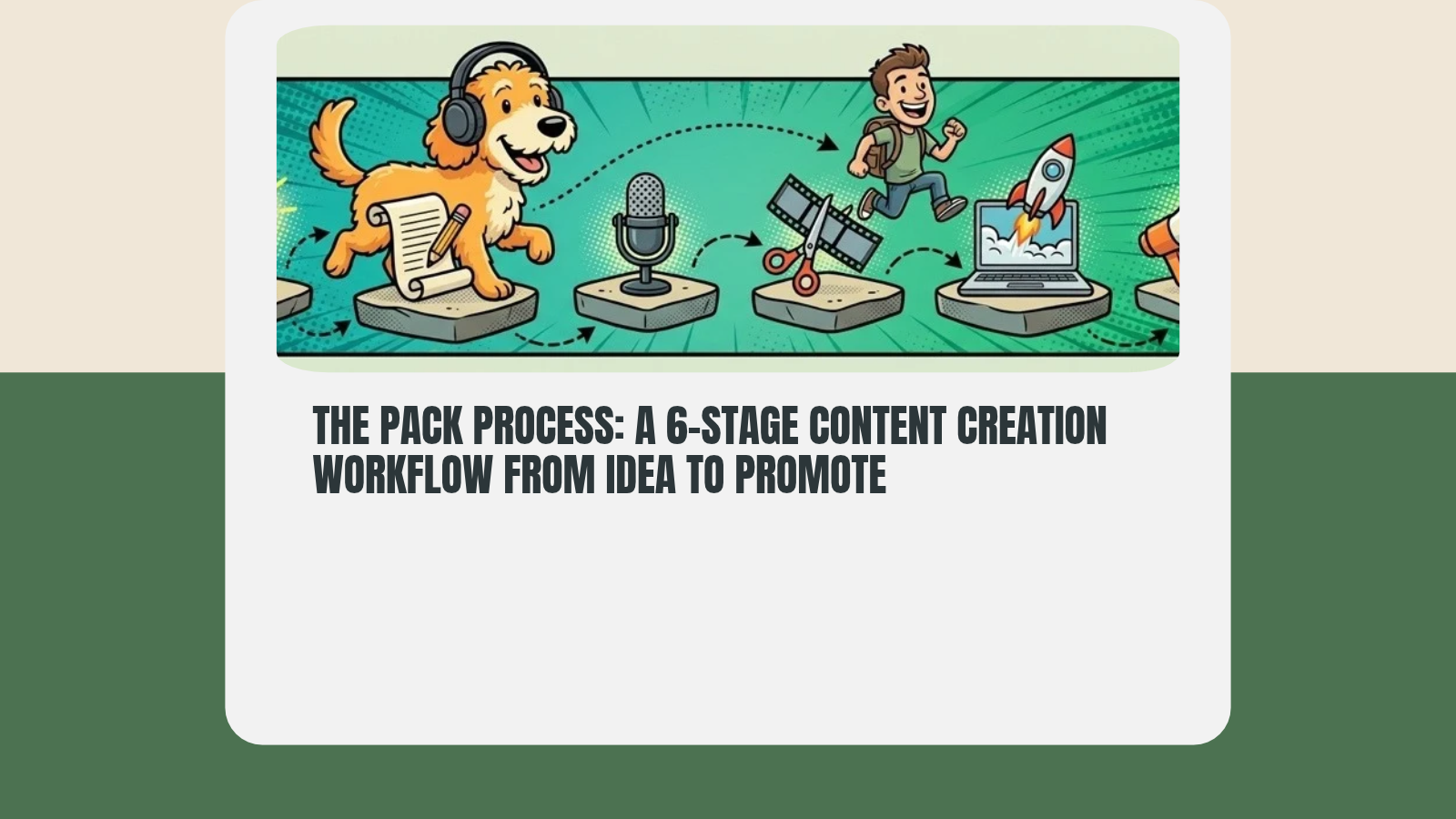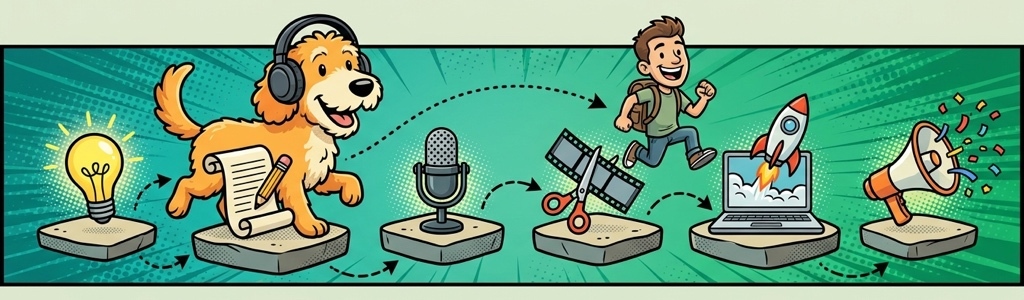
Staying consistent as a content creator takes a repeatable content creation workflow that moves each piece from idea to published. The Pack Process gives you that in six stages: Idea, Script, Record, Edit, Publish, and Promote. This post covers why winging it leads to quitting, what each stage looks like, and how to tell when a stage is done.
We've all been there. You sit down to create, and you stare at a blank document. You don't have a process or a plan; it's just you, the blank screen, and the growing feeling that there must be a better way.
Forced into a corner, you just wing it and throw something together. It might be good, but maybe it feels rushed and not up to your standards, but at least it's done.
The next week you remember how it went and nope out. Before you know it, you've missed three weeks, and your audience has moved on to your competitor who swooped in to take your place.
This is how podfade happens: YouTube channels go dark, and newsletters die, even when the creator still has plenty of ideas and passion.
Why Does Winging It Lead to Quitting?
Content creation at any level doesn't scale without a process.
When you "wing it", every piece of content requires the same massive effort. This is because you're reinventing the wheel every time. That burns through your willpower as if it were unlimited, and it isn't.
Some days you'll feel like you're on fire, knocking out tasks and building your task streak. Other days you can barely get the energy to read your emails, let alone respond to them. That's a normal part of the human condition. So you shouldn't be expecting yourself to post from zero every time because that introduces a ton of friction to your process.
That friction adds up, and the decision fatigue compounds until you're too exhausted to keep going.
What Is The Pack Process?
We created The Pack Process to help remove the friction and decision fatigue of consistent content creation. It's a six-stage system that takes the guesswork out of your workflow and replaces it with clarity, structure, and, best of all, momentum.
The Pack Process contains six distinct stages:
| Stage | What you do | Done when |
|---|---|---|
| 1. Idea | Capture and prioritize your content ideas | You've pulled the top idea from a prioritized idea bank |
| 2. Script | Turn the idea into an outline or script | You've read it out loud once and could record from it today |
| 3. Record | Capture your audio, video, or raw words | The raw content exists, with no editing along the way |
| 4. Edit | Cut, fix, and polish the raw content | It meets your "good enough" standard |
| 5. Publish | Upload, write descriptions, and schedule | It's live or scheduled and every checklist item is checked |
| 6. Promote | Share and repurpose it where your audience hangs out | It's out on each platform in a format that fits |
Each stage has a specific purpose and builds on the one before it. When you follow the process every time, you stop winging it and start building a sustainable content creation habit.
What Are the Six Stages of a Content Creation Workflow?
Stage 1: Idea
Every piece of content starts with an idea. Most creators treat idea generation like it's heaven-sent. They wait for their muse to tell them their next amazing idea and then scramble when they need something out tomorrow. The result is content that misses what your target audience needs, so you might as well not bother.
Our Idea stage is about a system for capturing, organizing, and prioritizing your content ideas so when it comes to the Script stage you have 100 options and not a blank page staring back at you. This means you create and maintain an idea bank, understand your audience's pain points, and then know which ideas are worth pursuing at your current stage in your journey.
We're fans of not waiting until you need an idea to start collecting them. Getting Things Done (GTD) highlights the idea that you should capture ideas as they come to you. In the shower, at the gym, and dropping your kids off at school are all wonderful "off" times for your brain where ideas might come to you. If you're anything like a normal person, you say "I'll remember that" but then don't.
Start collecting your ideas as they come to you. Capture the "bad" ones too, because the goal is to get all of them out of your head. You can decide later that you don't like an idea anymore.
Part of this is an idea review/prioritization process where you go through your ideas and make two basic decisions:
- Is this still a good idea, or should I delete it? An idea that sounded great a month ago might not be anymore.
- When should I convert this to content? Basic prioritization.
GTD says to do this at least weekly, and that cadence works well for content creators.
Stage 2: Script
The Script stage is where you convert that raw concept into a structured plan. As a podcaster, that might be an episode outline with talking points and questions. As a video creator, that might be a full script with shot lists. As a writer, it's a blog post outline with key arguments and facts.
Because you've already prioritized your ideas, you're pulling the top item(s) off your ideas list and implementing them.
Scripting helps reduce the pressure of "perfectionism" you might feel during recording by giving you something to say (and to refine before you have to think about what to do with your hands). The goal is the scaffolding you need for the recording. Polish comes later, in Edit. This is going to save you time editing later because you have a plan instead of rambling for a while.
Before you move on, read the outline or script out loud once. Any line that trips your tongue or loses your place on paper will do the same thing in Record, and it's faster to fix here than to cut around later.
At this stage you're helping "future you" create what will become the final product.
Stage 3: Record
Now it's time to create! Regardless of your output, is you're converting your script into raw content.
Keep a "separation of concerns" here. You're not editing while you record or second-guessing your outline (if you do go back one stage). You're executing the plan you made during the "Script" stage. This keeps you moving forward instead of falling into the perfectionism trap that's so common.
For podcasters or video creators, this means hitting the record button and getting what you need. For writers, it means getting raw words on the page. Don't judge it yet. Enjoy the process of creation.
Stage 4: Edit
Editing is where you take your raw content and polish it so it's professional and ready for your audience. You cut the fluff, fix mistakes, and add any final touches that will make it shine.
Editing happens separately from recording so you protect your momentum and prevent that perfectionism spiral that keeps it from getting published. Set a clear "good enough" standard for your content that matches your available time, energy, and skill. Not every piece needs to be a masterpiece, and you're unlikely to match the production quality of MrBeast.
Stage 5: Publish
Now it's time to release your baby into the world! The Publish stage includes sub-stages like uploading your content, writing descriptions, and making sure everything is live (or at least scheduled) and accessible.
Content creation advice often skips this stage, and that's a mistake, because a piece of content that sits unpublished doesn't exist. Treat "Publish" as a non-negotiable part of your process.
It's ideal to create a publishing checklist that you keep for each piece of content so you don't skip something important like running it through https://app.grammarly.com/ and realize you have a typo that makes a word a slur...
Stage 6: Promote
You've done it! You created something valuable and put it into the world for people to see. The Promote stage makes sure people see it.
You're going to share your content on social media, with your email list, in communities, and anywhere else your audience hangs out.
Too many creators skip this stage or do it as an afterthought. Promotion is how your content reaches the people who will resonate with it. If you build promotion into your workflow from the start, it won't get skipped, and your reach will grow.
We recommend repurposing your content for different platforms and not blasting your hour-long podcast to TikTok where no one will watch it all.
Why Do Systems Beat Motivation?
Motivation is one of the most unreliable forces in existence. Those on-fire days and can't-face-your-inbox days will keep coming, no matter how much you care about your work.
Systems are the exact opposite. Systems work whether you feel like it or not. When you follow a repeatable creation process like The Pack Process, low-motivation days won't stall your progress. You'll know what comes next, what success at each stage looks like, and it will help you build momentum through structure.
Systems are how you stay consistent and avoid podfade, burnout, and the guilt that comes with abandoning a project.
The Pack Process covers how one piece of content gets made. PodcastOps is how you run that process week after week: make the work visible, batch by mode, measure what you control, and review on a schedule. The weekly idea review from Stage 1 is one of those scheduled reviews.
How to Start Using The Pack Process This Week
- Start an idea bank and capture every idea, including the "bad" ones.
- Review your ideas once a week: delete what's gone stale and pick what's next.
- Outline or script the top idea and read it out loud before you hit record.
- Record without editing. If the outline is wrong, go back to Script.
- Set your "good enough" standard and edit to it.
- Build a publishing checklist and run it on every piece.
- Plan where you'll promote and repurpose the piece before it goes live.
We've written about most of these stages already:
- Idea: Why the blank page freeze isn't a willpower problem and Why content creators need a Getting Things Done system
- Record: Batch Recording Mastery and The Complete Guide to Double-Ended Recording
- Edit: The Perfectionism Trap
- Publish: The One-Episode Buffer and Why Your Content Calendar Is Your Consistency Superpower
- Promote: How to Repurpose a Podcast Episode Into a Week of Content and Podcast repurposing: 21 pieces from one episode
Subscribe to The Steady Pack and join the newsletter so the next stage deep dive lands in your inbox. We want to help you celebrate your first piece of content as well as your hundredth.