Batch Recording Mastery: How to Record a Month of Content in One Day
Scott Keck-Warren • March 8, 2026
It's Tuesday morning. You open your laptop, stare at your notes, and start brainstorming your next piece of content. Two hours later, you've got an outline. You record it that afternoon. On Wednesday, you edit. On Thursday, you write show notes and create social posts. Friday, you finally publish.
Next week, the entire cycle begins again.
By the third piece, you're already dreading the process. By the sixth, you're wondering if content creation is worth it. There's a better way, and it starts with understanding why this approach is killing your momentum.
The hidden cost of context switching
Nobody tells you this about producing one piece of content from start to finish before moving to the next: your brain is doing way more work than it needs to.
Content creation involves a series of discrete steps, and every time you switch between them, there's a cognitive cost. Your brain needs time to get into the right mode, and just when you've hit your stride, you're done and moving on to something else.
Multiply that by four pieces of content, and you've context-switched twelve times in a month on top of everything else. I don't know about you, but for me that's exhausting.
Each task ends up feeling harder than it should. Editing feels draining because you're still half in "recording mode" from earlier. Writing show notes feels tedious because you're already thinking about next week's topic. Nothing gets your full, focused attention, and the quality suffers for it.
Even worse, this approach makes content creation feel like it never ends. There's always another piece looming, always another deadline. The treadmill never stops, and that's exactly how creators give up.
The solution: batch everything
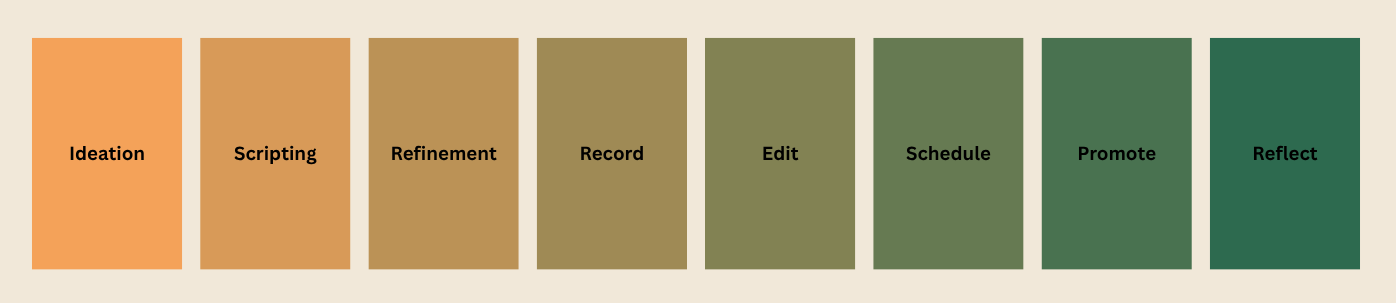
Instead of taking one piece of content through every stage before starting the next, batch similar tasks together. For video content, that means developing all your ideas at once, writing all your scripts together, recording everything in one session, editing in batches, and scheduling the whole month.
This works because your brain can stay in one mode at a time. It cuts the mental tax that makes content creation feel like a grind, and it genuinely saves time.
With enough practice, you can run this entire pipeline in a single focused day and actually feel energized at the end of it.
One thing worth saying upfront: none of these phases have time limits, and that's intentional. Unless you have a boss who's imposing a deadline on you, try not to stress yourself with unnecessary constraints. That said, you still need to set some kind of limit, because progress over perfection is the whole point here.
Phase 1: Ideation
Start your batch by developing all your content ideas in one sitting. Don't record anything. Maybe jot down a few ideas for what you want to cover, but don't write full scripts yet. Just get the core concepts locked in.
A running list of content ideas helps here. When batch day arrives, you're selecting from ideas you've already captured, not starting from scratch.
A content calendar is also useful for tracking release order, especially if you're timing anything around major holidays or events.
Phase 2: Scripting
Now that you have solid concepts, write the scripts or detailed outlines for all four pieces of content. Stay in writing mode. Don't jump to recording yet.
If you speak from an outline, aim for detailed bullets with key phrases or stats you want to include. If you script word-for-word, focus on conversational language, not polished prose.
Phase 3: Refinement
This is the phase most content creators skip, and it's a mistake. Before you record, give your scripts at least one editing pass while you're still in writing mode, then run them through a tool like Grammarly to catch typos that might trip you up mid-take. Then read each script out loud (yes, actually speak it) to catch any clunky parts.
After this pass, your scripts should feel like natural conversation, not like you're reciting an essay.
Phase 4: Record
Record all four pieces back to back. Because you've done the prep work, this will feel surprisingly easy.
Your energy will vary across the session, so record your most important or challenging piece first when you're freshest. Save the easier or shorter pieces for later when fatigue starts to creep in. Take breaks when you need them, and keep warm liquids on hand to keep your voice ready.
Phase 5: Edit
Now you have raw recordings. Time to work through them all.
Build an editing checklist: remove long pauses, add music, normalize audio, set export settings, and so on. Apply the same process to each piece. Doing them all in sequence means you're less likely to skip a step on one of them.
If your editing software has batch processing, use it. Apply the same noise reduction or compression settings across all four pieces at once.
Phase 6: Schedule
You've got four polished pieces of content. Get them queued up so you don't have to think about publishing until next month.
While you're in this mode, batch the show notes, thumbnails, and social media posts too.
Phase 7: Promote
The most skipped step. Promote early, often, and widely.
Phase 8: Reflect
Look back at what went well and what didn't. Maybe you realized you could have made editing easier if you'd paused longer between sections when recording. Maybe you thought of a way to create a vertical video from each post and need to start scripting for that.
Write it down and fold it into your process next time. The goal is to get a little better with each batch.
What this means for your content
When you switch to batching, the dread goes away. That might sound like an overstatement, but it's the thing people notice first. Instead of that constant low-level anxiety about the next piece, you get one focused day and then actual breathing room. You can watch your content go live without already panicking about what comes next.
Quality tends to go up too, which makes sense when you think about it. You're not half in recording mode when you're editing. You're not half thinking about next week's topic when you're writing this week's script. You're just doing the one thing.
That's also what makes it sustainable. The creators who don't quit aren't better at self-motivation. They've built workflows where consistency is easier than stopping. Batching is one of those systems.
Batch recording meets smart systems
The pipeline approach only works if you can see where each piece of content is in the process. When you're juggling four pieces across multiple phases, tracking it all in your head (or across scattered notes) brings the friction right back.
That's why we built Unleashed Podcasts around this workflow. You can see all your content at once, each piece at its own stage in the pipeline, without digging through folders or trying to remember what you already finished.
Sign up free and give the system a real batch day.
Shareable Images

Never Miss an Episode
Subscribe to The Steady Pack and get weekly systems, accountability tips, and strategies for consistent creators.
Join the pack and build systems that help you stay consistent.Need help organizing your podcast workflow?
Unleashed Podcasts helps you stay organized with best practices guidance and tools that reduce friction in your podcast creation process.

Social image checklist 3 missing