Why content creators need a Getting Things Done system
Scott Keck-Warren • May 24, 2026
We've all been in this situation, you sit down to work for an hour (maybe two if things go your way). But then you spend the first twenty minutes staring at the wall trying to figure out what to do.
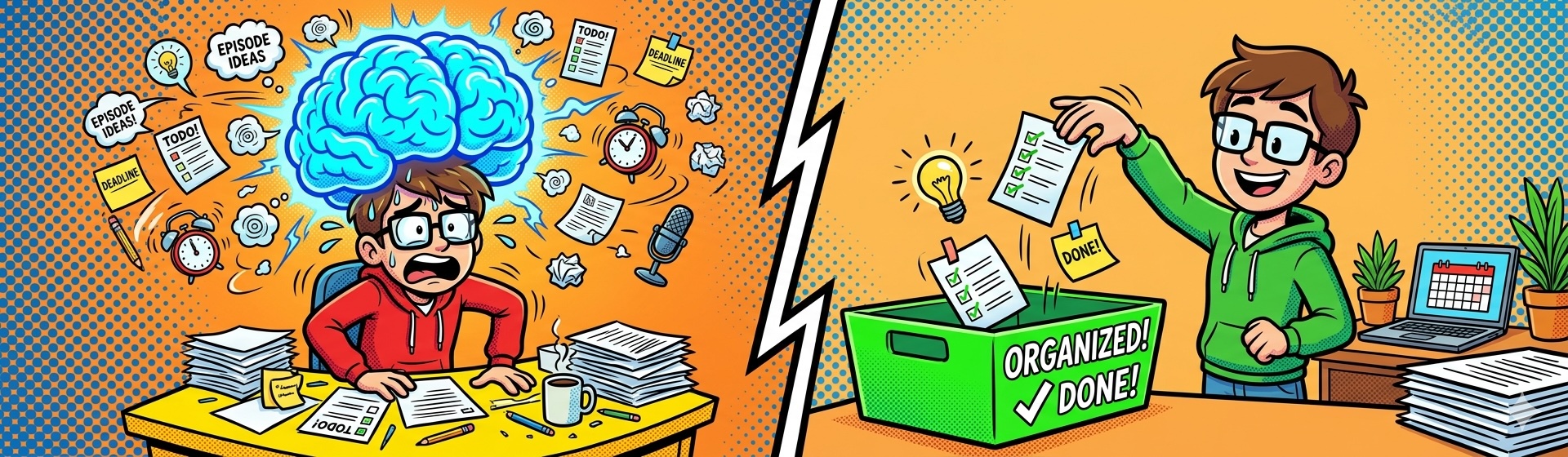
It's not because you're lazy or you don't care. Because everything you need to do is living in your head, and your head is a terrible place to store things.
That feeling, that foggy "okay, but where do I actually start" feeling, is not a productivity problem. It's a system problem. And there's a book from 2001 that explains exactly what's happening and what to do about it.
Your brain is a bad filing cabinet
David Allen's Getting Things Done (GTD) is built on one deceptively simple idea: your brain is designed for thinking, not for storage. It's great at making connections, solving problems, and generating ideas. It is absolutely terrible at holding a running list of everything you need to get done.
When you ask your brain to remember "record episode 14, finish editing episode 13, write show notes for episode 12, and post social for episode 11" all at once, it doesn't quietly file those away and wait. It runs them in the background constantly. Like a fan that never turns off. You'll be cooking dinner and suddenly remember the show notes. You'll be in the shower and feel vaguely guilty about episode 11. You'll sit down to watch TV, and there's that low hum again, that ambient stress of things not done.
That background hum is exhausting. And it has nothing to do with how much you actually have on your plate. Even a manageable workload, held entirely in your head, will wear you down.
GTD's answer is to capture everything into a trusted external system and get it out of your head entirely. It's not just big projects, but everything. Every half-formed episode idea. Every "I should really follow up on that." Every task is in a state of "I'll get to it." All of it, out of your brain and into something you trust.
The moment it's captured somewhere reliable, your brain lets it go. That's the whole mechanism. It doesn't sound revolutionary until you actually try it.
What a content creator's GTD system actually needs
Content creation has a lot of moving parts. Episode ideas, recording tasks, editing, show notes, publishing, promotion, and audience engagement. Each episode is basically a small project with multiple phases, and you're usually running two or three episodes at different stages simultaneously.
We content creators need four things to make this work.
First, a capture inbox. One place where everything goes. Episode ideas, tasks, links you want to reference, things people said in the comments that sparked a thought. The specifics don't matter as much as the rule: when something occurs to you, it goes in the inbox immediately, not into your memory.
A list of actual next actions. Not projects, not vague intentions. Specific things you can do in one sitting. (More on why this matters below.)
A way to track what's in progress. Which episodes are in which stage? What's recorded but not edited. What's edited but not published. A simple kanban board or even a table in Notion handles this fine.
A regular review. Weekly, at a minimum. Nothing else in GTD works without this.
"Work on podcast" is not a task
This is where most task lists fail, and it's where GTD gets genuinely useful.
Vague tasks don't get done. "Work on podcast" looks reasonable when you write it down, but when you sit down to actually do it, your brain has to do a whole extra step of figuring out what "work on podcast" means right now. That step is friction. And friction is exactly what makes you decide to check Twitter instead.
GTD calls the solution "next actions." A next action is the specific, concrete, physical thing you would do if you sat down right now. Not "episode 14" but "Record the intro segment for episode 14". Not "show notes" but "Write the three key takeaways section of episode 12 show notes".
The difference sounds pedantic until you notice that the specific version takes zero mental effort to start. You open the file, you do the thing, you close the file. The vague version requires you to figure out what you're doing before you can even begin, and that moment of figuring out is where a lot of creators quietly bail.
When your task list is full of next actions, it becomes something you actually use instead of something you feel guilty about ignoring.
The weekly review is the part nobody wants to do
GTD falls apart without a weekly review. A lot of people build a solid capture system, use it for two weeks, and then watch it go stale because they skipped the review. Worth being honest about that up front.
The review doesn't need to be elaborate. Ten to fifteen minutes, once a week. You scan everything that's open. You check that your next actions are still accurate. You move things forward, close out what's done, and make sure nothing is sitting in your inbox waiting to be processed.
That's it. The point isn't to do everything in the review. The point is to look at everything, so your brain knows the system is trustworthy. Because the only way your brain will actually let go of things is if it believes your external system has them. The review is what maintains that trust.
If you've tried GTD before and it didn't stick, skipping the review is almost certainly why. Not because the system was wrong for you.
One more thing
We built Unleashed Podcasts as a GTD-style system for podcasters specifically. Tasks are tied directly to episodes, so nothing floats free in a generic to-do list. There's a weekly task structure so your review has a built-in home. And the whole thing is designed so you can sit down, see exactly where each episode is, and know what to do next without burning twenty minutes on orientation.
If you've been carrying your whole podcast workflow in your head and wondering why it feels so heavy, this was built for that. You can check it out at unleashedpodcasts.com/.
Your brain has better things to do than remember which episode needs show notes.
Shareable Images
Never Miss an Episode
Subscribe to The Steady Pack and get weekly systems, accountability tips, and strategies for consistent creators.
Join the pack and build systems that help you stay consistent.Need help organizing your podcast workflow?
Unleashed Podcasts helps you stay organized with best practices guidance and tools that reduce friction in your podcast creation process.

Social image checklist 3 missing