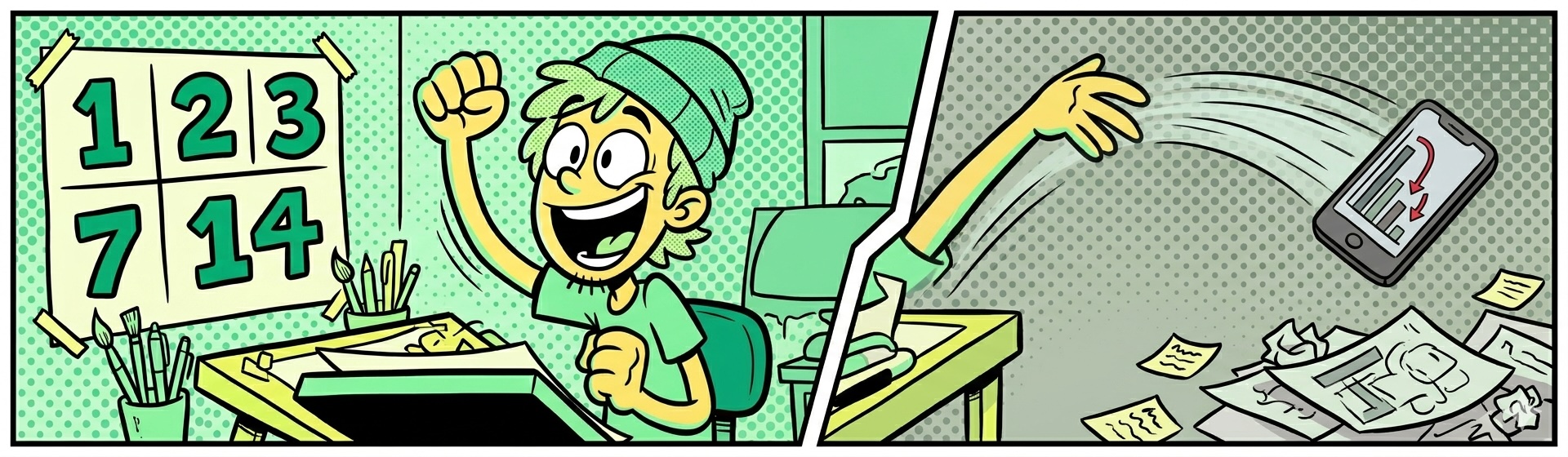
Why output metrics beat vanity metrics for new creators
Scott Keck-Warren • May 17, 2026
You hit publish and close the tab. You give it maybe twenty minutes, thirty if you've got unusual self-control, and then you open it again.
Zero views. Or five. Or twelve, which feels like a lot until you realize three of them were you refreshing to see if the embed loaded correctly.
I've done this as have most creators. You spend hours on something and the platform hands you back a number that wouldn't fill a minivan. And then you do the thing you absolutely should not do: you start treating that number as a verdict on the work.
Hopefully, you're realized that it isn't. But your brain is hungry for feedback on whether any of this was worth doing, and it will grab the nearest number and run with it and that's the trap.
What vanity metrics actually measure
Subscriber count, view count, downloads, these are real signals, eventually. Over time they tell you whether content is resonating, whether your distribution is working, whether a topic landed. Those signals genuinely matter.
In month one or two, they mostly measure things you can't control. Whether the algorithm picked your content up. Whether you posted on the right day. Whether someone with a big audience happened to share it. Whether you're in a category that gets surfaced easily or one where you're up against people who've been publishing for five years. Platform behavior, timing, luck. Not your consistency. Not how much you're improving. Not whether you're building something real.
Treating those numbers as a scorecard when you're new isn't just demoralizing; it's measuring the wrong thing entirely. You're grading your effort on a curve set by factors completely outside your control. That's a reliable path to podfade, and podfade is the one guaranteed way to make sure nothing ever grows.
Output metrics: the thing you actually control
Output metrics work differently. They count what you did, not how the world responded.
Output metrics are things like episodes recorded, posts published, or consecutive weeks you showed up. These numbers go up every time you do the work, regardless of whether anyone watched, read, or subscribed. They're yours so no algorithm touches them and no platform update wipes them out. A bad distribution week doesn't change them.
This matters because of control. When you decide to record on a Tuesday morning, that's 100% within you sphere of control. Nobody else is in that decision. You cannot wake up Tuesday and decide to have 500 more subscribers by Friday. You can't negotiate with platform math or will an algorithm to surface your episode.
The only lever you actually pull is your output. If that's the only lever you have, it's the only thing worth measuring. And measuring it is the most honest thing you can do for yourself right now.
What this looks like in practice
Output tracking doesn't need to be complicated. A running episode count is a solid starting point. Episode 1. Episode 2. Episode 7. Episode 14. That number goes up and it never goes backwards. Even when your download chart looks depressing, the episode count keeps climbing. That matters more than it sounds, because your brain is pattern-matching on "is the work actually getting done" and a rising total gives it a clear yes.
Streaks work well too. Consecutive publishing weeks, or consecutive days you touched the project. Streaks have real psychological weight. Once you've got a six-week streak going, the idea of breaking it genuinely hurts. That discomfort is doing motivational work that has nothing to do with subscriber counts. I'm not above admitting I've published episodes specifically to protect a streak. No regrets.
A simple monthly total also does the job really well. You created ten pieces of content in April and twelve in May. Progress you can see, measured entirely by your own behavior.
The goal is a number that goes up because of something you did, not something your audience did. You need at least one metric like that in your life as a creator, especially early on.
The long game (and why the external numbers do eventually matter)
Subscriber count isn't meaningless. Growth is the goal, and at some point the external numbers are exactly what you should be watching.
But subscriber count is a lagging indicator. It reflects consistent output that happened weeks or months ago. It's the result, not the process. If you've been publishing for six months and the external numbers still aren't moving, that's worth paying attention to. Maybe the topics aren't landing. Maybe distribution needs work. Those are things worth investigating.
In week three, it's noise. In week three, you haven't given the work enough time to accumulate. You haven't let the algorithm see a pattern. You haven't built enough of a body of work for anything to compound. The output is still the only thing in your control, and it's the only thing that will make the external numbers move later.
Consistent output first. External growth second. You don't get to run those in parallel when you're starting out. Do the output. The numbers follow.
Tracking that makes the work feel counted
We've built output tracking directly into Unleashed Podcasts because this is the problem we wanted to solve. When you log published episodes, complete tasks, or reach out through our bookings module, you earn XP and unlock badges. The system gives you a reliable signal that the work was done and counted, even on the weeks when the platform numbers are flat and the download chart looks like a disappointing EKG.
If you're in that early stage where you're doing the work but the world hasn't noticed yet, this was built with you in mind. You can check it out at unleashedpodcasts.com/register.
The external metrics are coming. Track your output, stay consistent, and give them time to catch up.
Shareable Images

Never Miss an Episode
Subscribe to The Steady Pack and get weekly systems, accountability tips, and strategies for consistent creators.
Join the pack and build systems that help you stay consistent.Need help organizing your podcast workflow?
Unleashed Podcasts helps you stay organized with best practices guidance and tools that reduce friction in your podcast creation process.

Social image checklist 3 missing