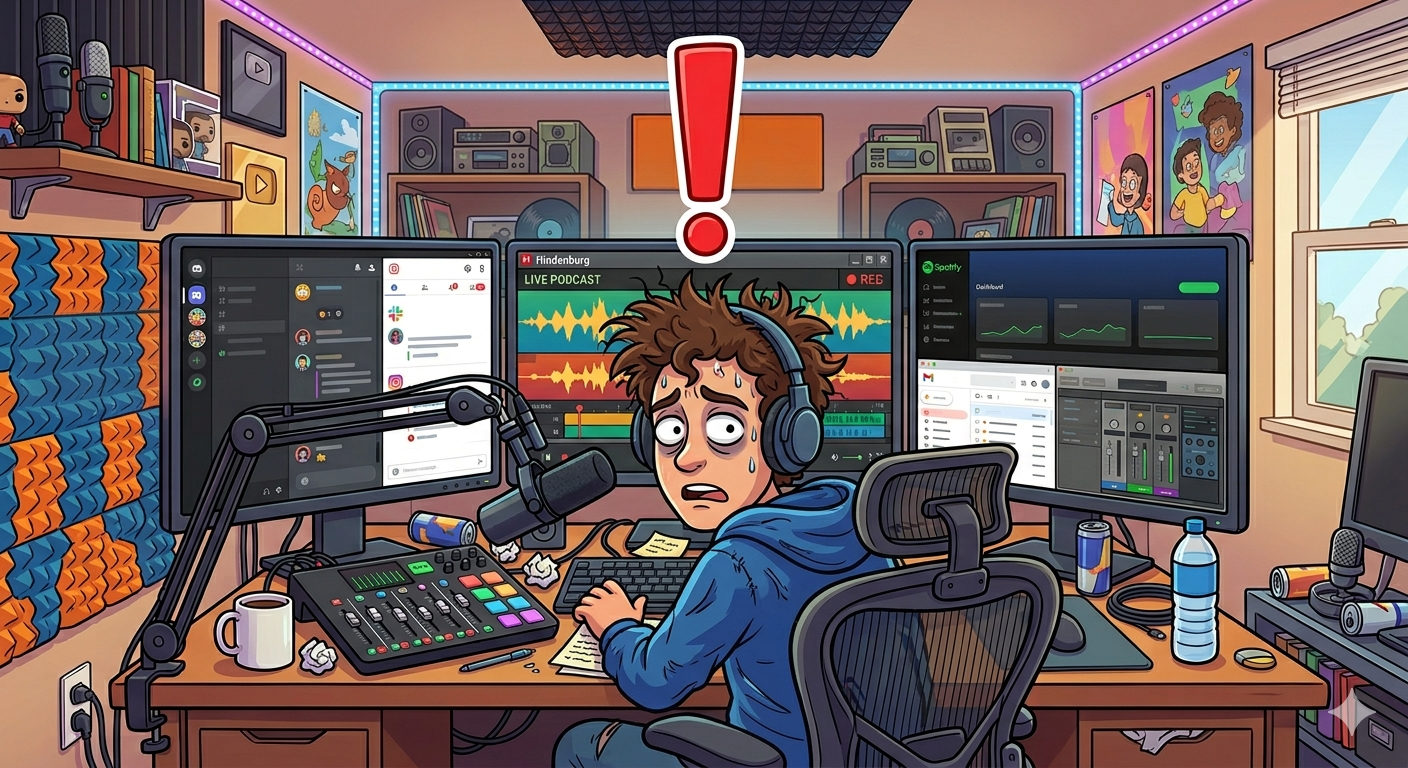
How to Eliminate Decision Fatigue from Your Content Workflow
Scott Keck-Warren • April 19, 2026
I have a section of my closet specifically for shirts I wear when I record. They're in a rotation, so my next recording session gets whatever shirt is next on the rack. I don't spend one second thinking about it. I don't stand in front of my closet trying to decide if the blue one looks better on camera than the gray one. I just grab the next shirt, put it on, and sit down.
It's a system, and when it's a system, it's not "laziness". But the huge benefit is that it saves me a decision I genuinely don't need to be making at 7am before a recording session.
What decision fatigue actually is
Every choice you make costs something. It's not money, but some of your precious mental energy. And you don't get an unlimited supply of it each day.
Researchers have found that the more decisions people make throughout the day, the worse their judgment gets on later decisions. This is why judges are statistically harsher just before lunch. It's why you end up ordering pizza on a Tuesday night even though you planned to cook, because you made 200 small decisions before you got home, and now your brain wants the path of least resistance.
For content creators, this shows up constantly, and it's usually "invisible".
The hidden tax on your creative energy
You probably don't think of your content workflow as a decision-heavy activity. But walk through a typical recording day and count the choices.
What's the episode structure going to be today? Should I do a cold open or go straight into the topic? How long should the intro be? Should my show notes go long or short this week? What format should I use for the description? Do I need to create a different version for the blog?
None of those feel like big decisions, but they can really stack up, and by the time you sit down to actually record, you've already spent your energy on a dozen choices that didn't need to be made in the moment. You could have made those decisions once, weeks ago, and never made them again.
That energy drain is why so many creators feel tired before they even start. It's not the content that's exhausting but the overhead around it.
Templates: make the decision once
The most effective thing you can do for your workflow is to template your recurring decisions.
Your episode structure doesn't need to be created fresh every week. Pick one and write it down. Whatever works for you should be documented so you can stop deciding and start creating.
Same with show notes, when you write them in a different format each and every week, you're reinventing something that doesn't need reinventing. Build a template with the sections you want and fill it in so the thinking can go into the content and not the structure.
Guest outreach emails are another big one. How many times have you opened a blank email to a potential guest and stared at it for ten minutes trying to find the right tone? Write one really solid outreach email, save it as a template, and tweak the details for each person. The core message is already done, so you're just personalizing the message (doing your best to make them realize you actually looked them up), not creating from scratch.
Unleashed Podcasts has reusable email templates and show notes templates built in specifically for this reason. The decision about format gets made once, and after that, you're filling in details, not building from a blank slate every time.
Checklists: your pre-flight routine
Pilots don't just decide if they want to check the fuel and flaps before takeoff; instead, they run through a checklist. The decision about what to verify was made when the checklist was written, so they don't spend mental energy on it during the flight prep.
Your recording sessions and publishing workflow deserve the same treatment.
A pre-recording checklist might cover: microphone connected, recording software open, phone on silent, water nearby, and notes doc open in a second window. It takes thirty seconds to run through and removes all the "oh no I forgot..." moments mid-session or worse while you're editing.
You can also have a publishing checklist that might cover things like show notes written, episode uploaded, thumbnail created, description added, links checked, and newsletter queued. You're not trying to hold everything in your head, hoping you don't forget something (because you will). You're following a list someone (you, past you) already thought through.
In this case, past you was smart, and you should trust past you.
SOPs: the stuff you do every week on autopilot
A Standard Operating Procedure sounds corporate, but it's really just a written-down version of "here's exactly how I do this recurring task." An SOP for your weekly content workflow might be a single document that outlines, step by step, what happens from Monday's recording to Thursday's publish.
The goal isn't bureaucracy; instead, the goal is to never have to think about the process again so you can focus on the content.
The huge benefit of an SOP is that you can hand it off. If you're lucky enough to get a co-host or even "staff" to help you, an SOP will give you something you can easily pass off to them when you're sick or busy. Sometimes it will just helps sick solo you stay on track so you can still publish on time.
The clothing rack, applied to everything
The shirt rotation I mentioned at the start isn't just about clothes: It's a mindset.
For anything I do repeatedly, the question I ask myself is can I make this decision once and then take it off the table permanently?
The answer is almost always yes. I can pick my recording day outfit, episode structure, show notes format, guest emails,thumbnail style, intro music, and upload sequence in advance and then never think about it again.
Every time I find myself making the same decision twice, that's a signal. That decision should be a template, a checklist item, or an SOP. Not a recurring tax on my creative energy.
Where to start this week
Pick one decision you made this week that you've made before and remove that decision from your life. It doesn't have to be big, but it will be a start.
Write it down in a version you'd be happy with and make it a template or an SOP doc. And the next time that situation comes up, you're done deliberating because you've already decided.
One thing this week, you'll feel the difference immediately because you're not fighting your workflow anymore. You're following a system you built for yourself.
If you want a head start on some of this, Unleashed Podcasts has guest outreach email templates and show notes templates built into the platform, so you're not starting from scratch. You can sign up and take a look at unleashedpodcasts.com/register.
Shareable Images
Never Miss an Episode
Subscribe to The Steady Pack and get weekly systems, accountability tips, and strategies for consistent creators.
Join the pack and build systems that help you stay consistent.Need help organizing your podcast workflow?
Unleashed Podcasts helps you stay organized with best practices guidance and tools that reduce friction in your podcast creation process.

Social image checklist 3 missing