From Camera Shy to Camera Ready Using The Practice-Based Path to Video Confidence
Scott Keck-Warren • March 15, 2026
podcast-episodeThis has happened to us all: you hit record, the audio sounds great, your notes are solid, and you know your topic inside and out.
Then you see yourself on screen.
Your shoulders are tense, your smile looks forced, and you realized your hands kept touching your face. That easy, conversational tone you have in real life is gone. You over-rehearsed, like you're reading from a script even when you're not.
You watch the footage back, delete it, and rerecord it again, and maybe again.
You feel like you're bad at being on camera, but it's really that it's just new for you.
Why camera discomfort is so normal
For most of human history, being stared at by multiple people was a threat or, at best, a performance of some kind. Your brain isn't built for the modern reality of talking into a lens while imagining hundreds of invisible viewers.
Most people also go years without ever watching themselves speak. You've heard your voice in your head your whole life, but you've rarely watched yourself hold a conversation. When you finally do, the person on screen doesn't match your mental self-image.
A bad conversation in real life is forgotten by dinner. A bad video stays on the internet. The stakes are actually higher.
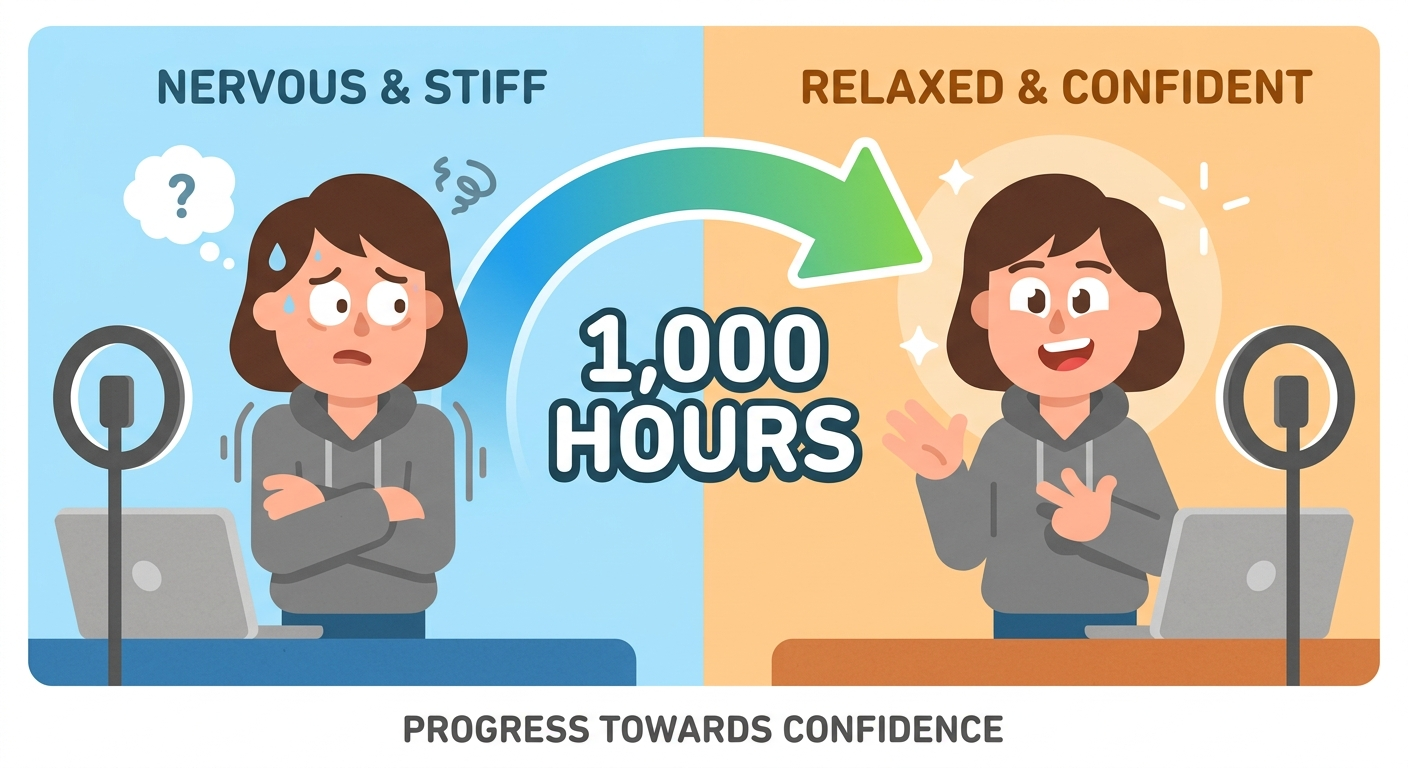
Stiff, awkward, overly aware of your own face: that's not a character flaw. That's what happens before the hours stack up.
The 1,000-hour rule
You've heard of the 10,000-hour rule. 10,000 hours to become world-class at something. It's seen as the "gold standard" for how much time you need to put into something to be an expert. It's useful for context, but it's not the number that matters here. Research suggests competence tips into genuine skill around 1,000 hours.
That still seems like a lot, but the math shifts depending on how often you practice:
- One 30-minute video per week: about 38 years. (Not great.)
- One hour-long video per week: roughly 19 years. (Still rough.)
- 20 minutes of camera practice every day: about 8 years.
- Daily 30-minute practice: around 5.5 years.
- One hour of daily camera time: under 3 years.
Most creators feel a real confidence shift well before 1,000 hours. The point is that camera shyness isn't a mental block you push through. It's a skill deficit you fill through repetition. Same as learning to drive: uncomfortable at first, less uncomfortable after enough time behind the wheel.
How to practice without just suffering through it
Suffering through the same bad recording session 50 times won't build skill. Deliberate practice will.
Start with no-stakes recording
Record practice videos nobody will see. Talk about anything for 2-3 minutes. Your day, a hobby, what you had for lunch. Watch them back. You'll start noticing patterns in your speech, your mannerisms, how you hold your hands when you talk (why do I rotate mine). That's the raw material you're working with.
Record about things you actually care about
After a week or two of throwaway recordings, start making short videos (5-10 minutes) on topics you're genuinely into. When you care about the subject, you stop monitoring yourself and start talking. Pick topics you could cover for an hour without notes. Enthusiasm is less self-conscious than polish.
Drill the first 30 seconds
The opening is when you're coldest. You haven't found your rhythm, and the camera still feels like a spotlight. Re-record the first 30 seconds of your video 10 times in a row. Different energy levels, different phrasing, different ways to hold yourself. Getting comfortable with that exposed first moment carries the rest of the video.
Put the camera in more contexts
Record a quick explanation of something you know well. Film a reaction to an article. Make a 60-second tip for social media. Camera-on becomes background noise faster than you'd expect when you stop treating it as an event.
Watch your own content back
Watch your videos with an honest eye. Find the moments where you felt natural. Pick one or two things to work on next time. One or two. Not 40.
Every awkward pause and every "um" tells you something. Track those and improve on them. Cataloging everything you hate about yourself doesn't.
The gap is just hours
The creators who succeed with video aren't born charismatic. They recorded when they were bad at it, watched the footage, and recorded again. That's the whole method.
Log the hours. Practice when nobody's watching. Publish the imperfect videos, because they move you forward in ways that waiting never will.
After enough hours, you stop thinking about the camera and start thinking about the content.
Start recording
Record one 3-minute practice video today. Don't publish it. Watch it back, find one thing you did well, and repeat tomorrow.
If staying consistent is the hard part, Unleashed Podcasts can help. Track your content, maintain a publishing schedule, and build the systems that make showing up automatic. Daisy (our virtual accountability coach) won't let you skip practice days.
Shareable Images
Never Miss an Episode
Subscribe to The Steady Pack and get weekly systems, accountability tips, and strategies for consistent creators.
Join the pack and build systems that help you stay consistent.Need help organizing your podcast workflow?
Unleashed Podcasts helps you stay organized with best practices guidance and tools that reduce friction in your podcast creation process.

Social image checklist 3 missing