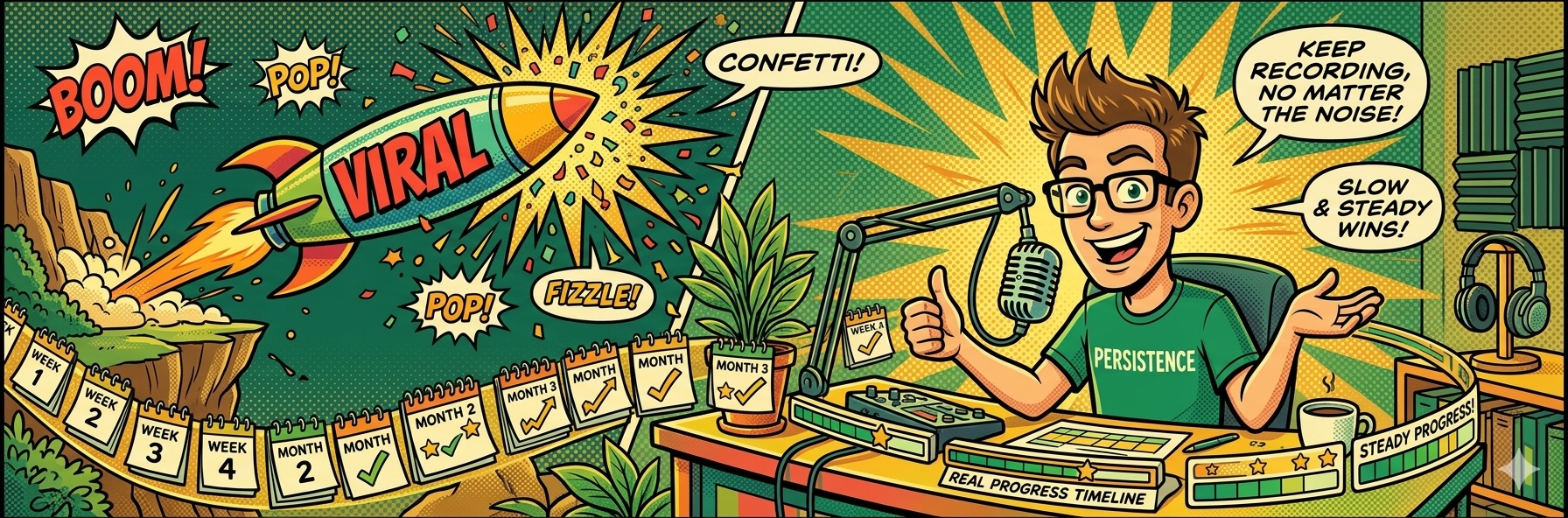
The Creators Who 'Made It' Didn't Have a Breakthrough. They Just Never Stopped.
Scott Keck-Warren • June 21, 2026
There's a story most of us tell ourselves when we start creating. It goes something like this: we put in the work, we get consistent, and then one day something makes us go viral. A video takes off, a post gets shared by the right person, and a guest brings a whole new audience through the door. That's the magic turning point, and when everything changes, so we can quit our 9-to-5 and do this full-time.
We've all heard some version of it. The podcast that exploded after a Reddit post. The YouTuber who went from 2 subscribers to 20,000 overnight. The newsletter that got picked up by a bigger newsletter and never looked back. The myth is seductive because it's real, because those things do happen in real life.
They're just not the pattern.
What actually happens to creators who last
When we at The Steady Pack look at creators who are still publishing three, four, five years in, the story almost never has a dramatic turning point. There's no moment where the algorithm smiled on them, and everything clicked into place. There is consistently this is a gap between when they thought they were going to quit and when they actually quit.
Which was never.
They kept going when the numbers were bad. They kept going when they had 40 listeners, and half of them were family members. They kept going through the episodes they hated, the seasons where nothing felt fresh, the months when every other creator in their feed seemed to be blowing up while they were stuck.
The compounding was quiet, and the growth was slow, but somewhere along the way, they became one of the creators who "made it". Not because they caught a break but because they were still there when everyone else had left.
Why virality is a trap
Here's the problem with optimizing for a breakthrough moment: it trains you to think about content the wrong way.
When you're chasing a spike, you start making decisions based on what might pop. You pick topics for their potential reach instead of your actual expertise. You copy formats that worked for someone else's audience. You chase trends that are already cooling off by the time you get there. But then every week you don't break through feels like proof that something is wrong with you, or your content, or your niche.
It's important to remember that: virality optimizes for the peak while longevity optimizes for the next episode.
Those aren't the same thing, and building a content practice around the first one actively undermines the second. A spike in downloads is great, but it means nothing if you burn out trying to follow it up. A viral episode that brings 500 new listeners to a feed that went quiet two months ago doesn't build an audience. It just shows strangers a ghost town.
Willpower isn't the answer either
So if we're not chasing virality, what are we doing? This is where a lot of creator advice goes sideways. It swings from "hack the algorithm" to "just be disciplined." It also includes "show up every day", "commit to the process", and "have a why".
That advice isn't exactly wrong, but it is incomplete. Willpower is finite, and motivation is unreliable. We all know this from experience, because we've all had the weeks where we were fired up and the weeks where we had nothing left. A content practice built on discipline alone is one hard day away from falling apart.
What sustains creators over the years is systems that make consistency the path of least resistance.
When recording is frictionless, you record. When your episode workflow is mapped out, you don't have to reinvent it every week. When you have a batching system, a backup episode ready, a guest pipeline that isn't dependent on a single email going through, you don't fall off just because life gets in the way for two weeks.
The creators who last aren't the ones with the most willpower. They're the ones who built an infrastructure that carries them when the willpower runs out.
Redefining what "winning" looks like
We want every creator in The Steady Pack community to make this shift: stop measuring success by the views, and start measuring it by your longevity.
Winning doesn't mean going viral. Winning doesn't mean you hit a download milestone or got a big sponsor or had a guest who blew up your numbers (although those are amazing and shouldn't be ignored).
Winning is still publishing six months from now.
That's the most important metric. Are you still here? Are you still making the thing? Because the creators who are still here in six months are the ones who will have the audience in three years. While the ones who burned out chasing a breakthrough won't.
Shift your perspective, and a lot of decisions get clearer. Can you sustain this pace? How do you make this easier to keep doing? Those questions point somewhere useful, and "Will this episode go viral?" doesn't.
That's building something real.
Systems are how you stay in the game
We built The Steady Pack around this belief, and it's why we talk about systems so much. Not because systems are glamorous (they're really not), but because systems are what let you show up when the inspiration isn't there, when the numbers are discouraging, when you'd honestly rather do almost anything else.
If you're a content creator looking for something that helps you build that kind of infrastructure, UnleashedPodcasts was designed with exactly this in mind. It's a platform that handles the organizational side of podcasting, so your energy goes into the work, not the overhead. You can check it out at unleashedpodcasts.com.
Whatever tools you use, the mindset shift matters more than the tool. Stop trying to win the week and start trying to still be here in six months.
That's how the creators who "made it" actually made it. Not with a breakthrough but a refusal to stop.
Never Miss an Episode
Subscribe to The Steady Pack and get weekly systems, accountability tips, and strategies for consistent creators.
Join the pack and build systems that help you stay consistent.Need help organizing your podcast workflow?
Unleashed Podcasts helps you stay organized with best practices guidance and tools that reduce friction in your podcast creation process.

Social image checklist 3 missing