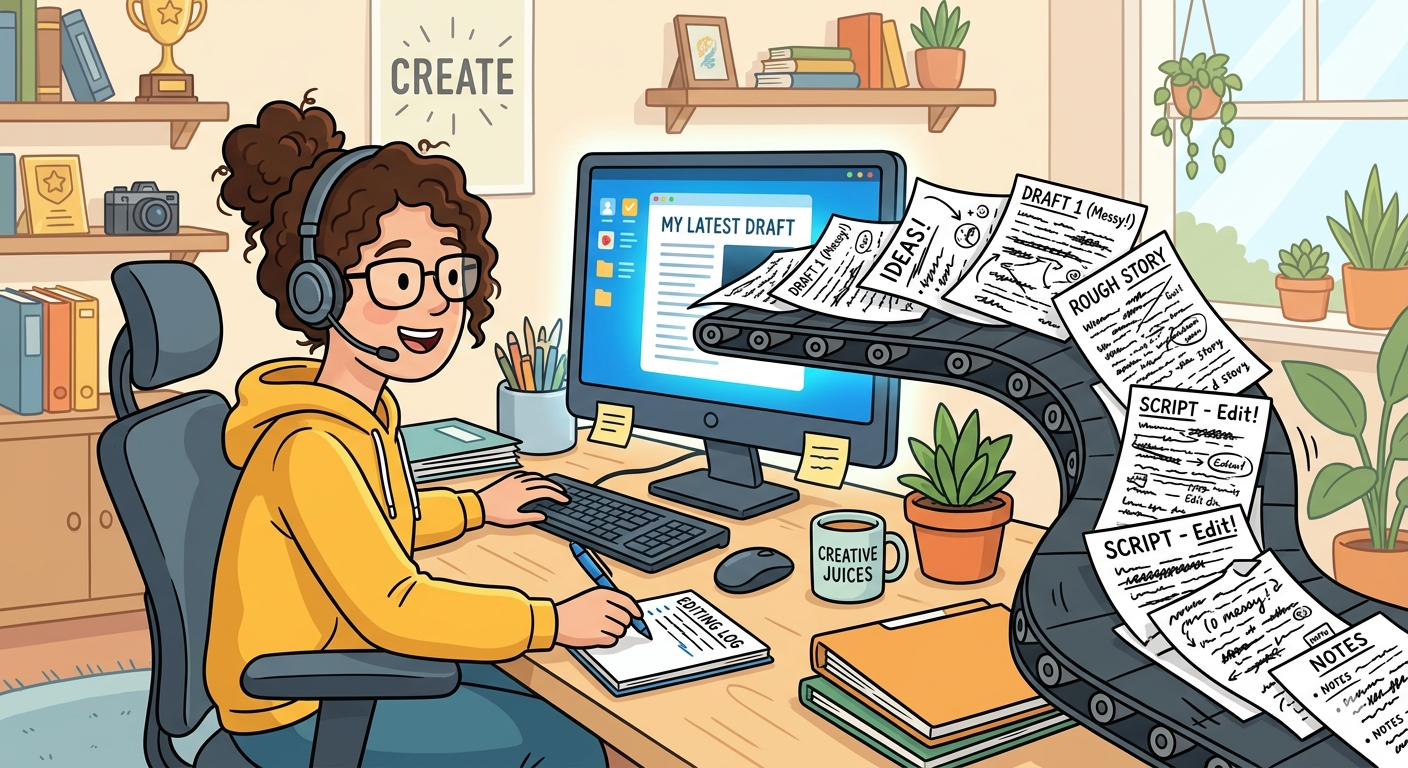
Claude Code as a Rough Draft Factory
Scott Keck-Warren • April 5, 2026
We've all been there, you know exactly what you want to say because you've thought through the points you want to cover, and you're at your computer ready to write. Then you open a blank document and stare at the cursor for ten minutes, type a sentence, delete it, and start checking email instead.
The blank page is the most reliable way for me to lose an hour. I know the material, but going from zero to one word can feel impossible.
The way most people use AI for writing (and why I hate it)
AI like ChatGPT or Claude allows a really low barrier to writing. You describe what you want, hit generate, and publish whatever comes back.
The problem with this is that it's VERY clear to internet-savvy users that this is what's happening. The resulting output sounds and looks like every other AI post on the internet. It's overly formal. Every section is labeled with a bold header. Sentences that start with "It's worth noting that" and paragraphs that end with "In conclusion." It's full of emdashes (which I'm going to miss using now that I know what it is). It doesn't sound like you. It sounds like a well-organized student paper by someone who read too many corporate memos.
That approach trades your voice for speed, and it's not a good trade because ANYONE can do the same thing, so we end up with a ton of "AI slop". I think there's a better way.
Building a style guide Claude actually uses
Earlier this year, I pulled together a bunch of my writing and fed it to Claude with the specific goal of analyzing how I write. I then had it analyze the text based not on the content of the writing but the style.
Elements like sentence length patterns, how I open sections, what transitions I use, what I avoid, and what the rhythm of my paragraphs looks like.
From that analysis, I built a file called scotts-voice.md. It covers things like how I use a "Friendly, direct, and conversational" tone (which I'm glad to hear it said instead of "mean and grouchy").
## Scott's Voice

### Tone and perspective
- Friendly, direct, and conversational — like a knowledgeable colleague explaining something
- First person throughout. Use "I" for personal opinions, experiences, and uncertainty ("I think", "I'm not 100% sure but", "one of my suggestions is"). Use "we" when referring to shared experience as a community or profession ("we can use", "we need to remember", "as developers we")
- Encouraging without being preachy. Never lecture.
- Light, self-aware humor where it fits naturally. Don't force it.
...
That file lives in my Claude projects and is portable to all of the computers I use (including my work computer). Every time I generate prose, Claude is working from that reference. It's not magic, and it's not perfect, but it gives the draft a chance of sounding like me instead of a generic AI slop.
The draft-post command
Now, when I'm ready to write, I don't start with a blank document. I open Claude and run my custom /draft-post or /draft-script commands. I give Claude the topic and main points I want to make, and the command runs that through my "scotts-voice" agent and generates a "rough draft" for me.
Now I could stop here and hit publish, but I'm never 100% happy with this stage of the output. Claude usually gets the structure right and lands the broad strokes, but it's not perfect. That's good, though, because the goal isn't perfect; it's to not be staring with a blank page.
Two more passes before I touch it
After the initial draft, I run two more automated passes before I start editing myself. I use stop-slop (https://github.com/hardikpandya/stop-slop) and humanizer (https://github.com/blader/humanizer), both of which clean up slightly different AI structing issues (and burn through a ton of tokens).
After both passes, the obvious AI tells are reduced (but not gone). The draft reads like something a human wrote, though not necessarily like me specifically.
The part that makes it mine
Now comes the "work", I go through the draft paragraph by paragraph and ask myself, "Would I actually say this?" Is this the example I would have used, or is this just straight garbage?
I'm editing for whether it's true to what I meant. Sometimes a whole section needs to be rewritten because the AI got the structure right but missed the point. Sometimes it's a few sentences that feel a half-step off. Occasionally, I read a paragraph and realize I don't believe what's written there.
Even if I rewrite 80% of the draft (which I might do even in this article), I finish faster than if I'd started with a blank page, just because the page isn't blank anymore.
Why this works, and what it isn't
Large Language Models like ChatGPT and Claude don't actually "think" in the way we think humans do (even if their companies want us to think differently), they're just software built to guess the next "best" word in a string of words. That's why it struggles with simple things, like whether you should walk to the car wash.
With that in mind, I'm not asking Claude to think for me. I'm asking it to give me something to push against so I can stop staring at a cursor.
It's faster. A few minutes to generate and run my custom cleanup pipeline to do a clean, then edit. My "total time" is shorter than it used to be, and I can produce more in the same time.
To me, it's not cheating. I'm still deciding what point to make, judging whether the draft got it right, and rewriting the parts that didn't because I'm seen as the "author" of the final piece.
This isn't a "generate and publish" setup. If I'm not willing to edit, the post doesn't go out. I've tried skipping that pass a couple of times when I was in a hurry, and the results were posts that technically covered the right topic, but I hated. Readers can probably tell too.
If you're working on your own content systems, this is the kind of thing we cover on The Steady Pack. Subscribe to the podcast or the newsletter, and you'll get new episodes and posts as they come out.
Shareable Images

Never Miss an Episode
Subscribe to The Steady Pack and get weekly systems, accountability tips, and strategies for consistent creators.
Join the pack and build systems that help you stay consistent.Need help organizing your podcast workflow?
Unleashed Podcasts helps you stay organized with best practices guidance and tools that reduce friction in your podcast creation process.

Social image checklist 3 missing